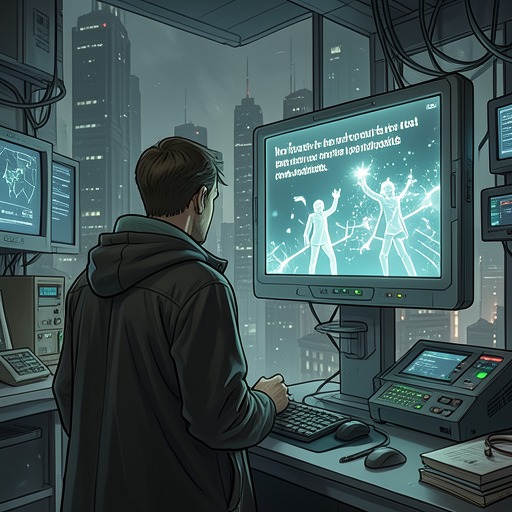
The ship is forced to land at End City
The Robot Who Looked Like MeThe ship’s forced landing at End City is a sudden reversal in an illustrative, second-person vignette: a traveler poised to enjoy the rewards of a successful life is taken instead to a place that cancels every prior assurance. The ship’s computer chooses the destination, and the traveler’s protest cannot change the outcome. The episode makes arrival itself the threshold to End City, where no paperwork or invitation is required.
The Expected Arrival
The scene begins not with danger but with an imagined triumph. The passenger is settled in a first-class seat on Fat Cat Spacelines, traveling from Depredation City on Earth to Spoilsville Junction on Arcturus XII. The trip seems to lead toward a future already prepared: Magda is waiting beyond customs, and a party in the passenger’s honor is under way at the Ultima Hilton. These details make the expected destination feel less like a point on a route than the culmination of a life’s work.
That success is described as hard-won. The traveler has spent a lifetime struggling and is now rich, attractive, successful, and respected, ready to enjoy what has been gained. The image of life as a greasy, rich ball of chicken liver makes the anticipated reward deliberately excessive and earthy. The passenger’s luxurious setting and self-congratulatory confidence give the landing its force: this is someone who believes the difficult part is over and that pleasure is finally due.
The Computer’s Decision
The landing sign flashes at the moment when the traveler is imagining arrival at the party. Asked why the plane is landing somewhere unplanned, the stewardess explains that the ship’s computer has taken it to End City and that the vessel must land there. The diversion is therefore not presented as a negotiation, an offer, or a human mistake that the passenger can correct. The computer has already determined the destination; the crew’s statement conveys that the decision is binding.
The passenger objects on the strength of a specific promise, invoking J. Williams Nash, the president of the line, as a trusted friend who had assured the traveler there would be no unscheduled stops. That appeal brings the ordinary protections of status and personal connection into the scene. Yet the stewardess answers that End City terminates all previous assurances. The wording makes the destination more than an inconvenient stop: it nullifies the passenger’s confidence that a promise from the head of the airline can guarantee control over the journey.
From Celebration to Involuntary Arrival
The turn is immediate. A moment earlier, the passenger’s mind was occupied with wealth, social standing, and the anticipated welcome at the Ultima Hilton; now the safety belt is fastened and the traveler thinks of bad luck. The remembered labor of getting ahead—lying, cheating, and stealing—sharpens the reversal. The traveler has endured a long struggle in expectation of a reward, only to have that reward deferred by a destination outside the plan.
The scene’s force comes from the gap between the promised itinerary and the actual landing, not from any described physical emergency. Nothing in the account suggests that the passenger can refuse, bargain with the computer, or resume the scheduled route. The transition from champagne and celebration to an unwanted arrival turns prosperity into no protection at all: the passenger may have achieved wealth and respect, but neither can make the ship honor its itinerary.
Entry and Narrative Function
End City’s rules of entry extend the logic of the diversion. Getting in is described as easy: a visitor need only arrive, park a spaceship in the junkyard, and come back later to meet the local men. There is nothing to sign and no need to worry about formalities. The ship’s involuntary landing thus supplies the condition that the place itself requires. Once the passenger has been delivered there, the boundary has already been crossed.
The vignette introduces End City through a collision between private expectation and impersonal destination-setting. The passenger’s first-class seat, scheduled route, personal connections, and promised reception all suggest a world in which money and assurance can organize experience. The computer’s decision breaks that pattern, while the casual instructions for entering End City make the break feel like the place’s defining custom. The episode does not describe what the passenger does after landing; instead, it ends by establishing the terms of arrival. In this frame, End City is not a destination the traveler chooses so much as one that becomes unavoidable once the ship sets down there.